

Kathleen Pithouse-Morgan, Daisy Pillay, Claudia Mitchell
Memory Mosaics: Researching Teacher Professional Learning Through Artful Memory-work
Communicates new voices, insights and artful possibilities within the field of arts-based educational research. Explores memory-work, arts-based research, and professional learning research, across diverse sociocultural and educational contexts
Includes unique arts-based exemplars of professional learning research through memory-work
Professor of Education
Kathleen Pithouse-Morgan
I am a Professor of Education at the University of Nottingham’s School of Education and an honorary Professor at the University of KwaZulu-Natal’s School of Education. My scholarship is in professional learning, understanding and supporting teachers and other professionals as self-reflexive, inventive learners who bring about context-appropriate and practitioner-led change. I am passionate about research and teaching strategies that draw from the arts and make use of creativity.

Published Books
Publications
Citations
What begins as research becomes an extended series of teaching experiences that lead to learning and growth for many, linking personal inquiries to a broader and evolving picture of community…
My Publications
Edited Books
Polyvocal professional learning through self-study research
Summary Polyvocal Professional Learning through Self-Study Research illustrates the power of “we” for innovative and authentic professional learning. The 33 contributors to this book include experienced and emerging self-study researchers, writing in collaboration,...
Productive remembering and social agency
Summary Productive Remembering and Social Agency examines how memory can be understood, used and interpreted in forward-looking directions in education to support agency and social change. The edited collection features contributions from established and new scholars...

Memory and Pedagogy
Summary Memory work – the conscious remembering and study of individual and shared memories – is increasingly being acknowledged as a key pedagogical tool in working with children. Giving students opportunities and support to remember and study their selves as...
Most cited publications
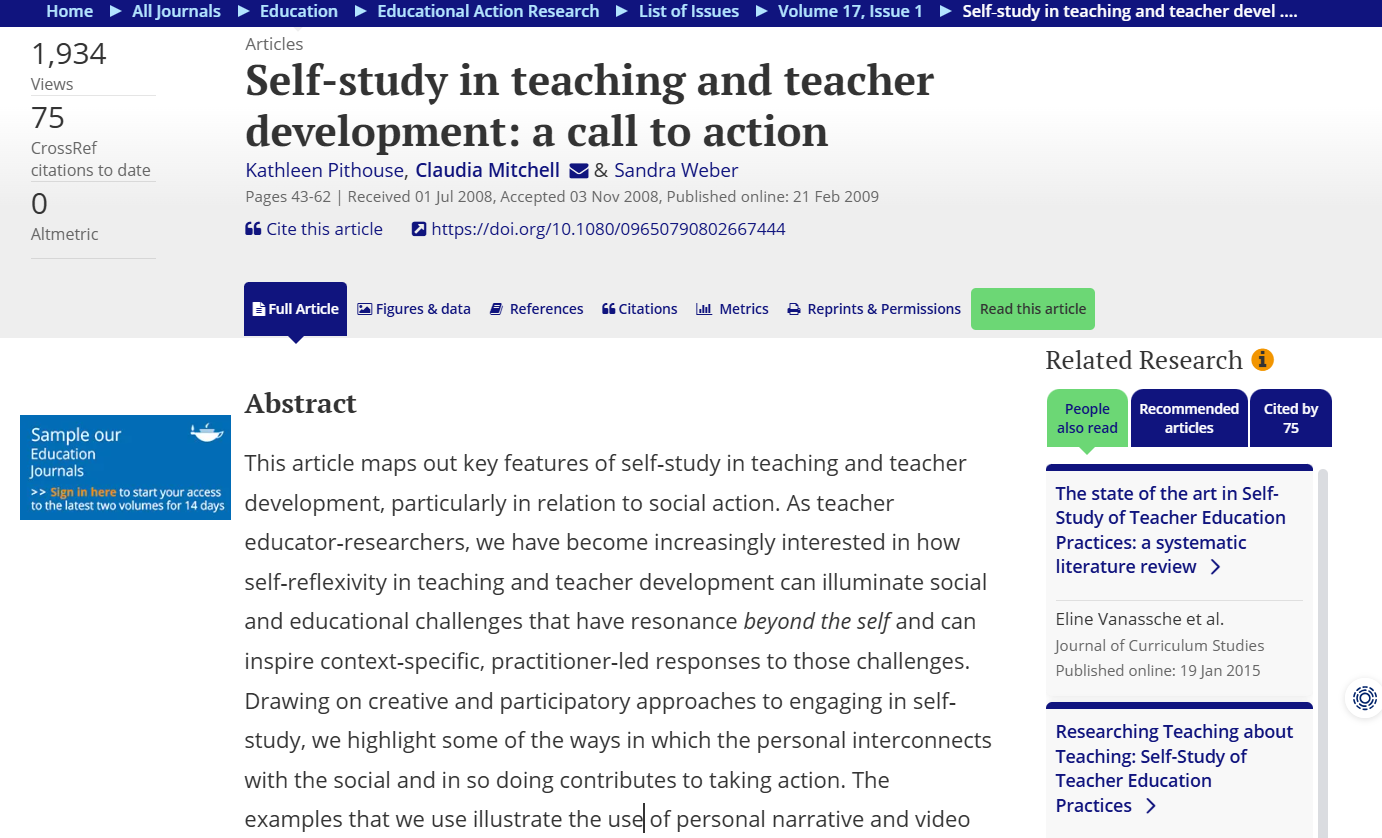
Self‐study in teaching and teacher development: A call to action
This article maps out key features of self‐study in teaching and teacher development, particularly in relation to social action. As teacher educator‐researchers, we have become increasingly interested in how self‐reflexivity in teaching and teacher development can illuminate social and educational challenges that have resonance beyond the self and can inspire context‐specific, practitioner‐led responses to those challenges. Drawing on creative and participatory approaches to engaging in self‐study, we highlight some of the ways in which the personal interconnects with the social and in so doing contributes to taking action.
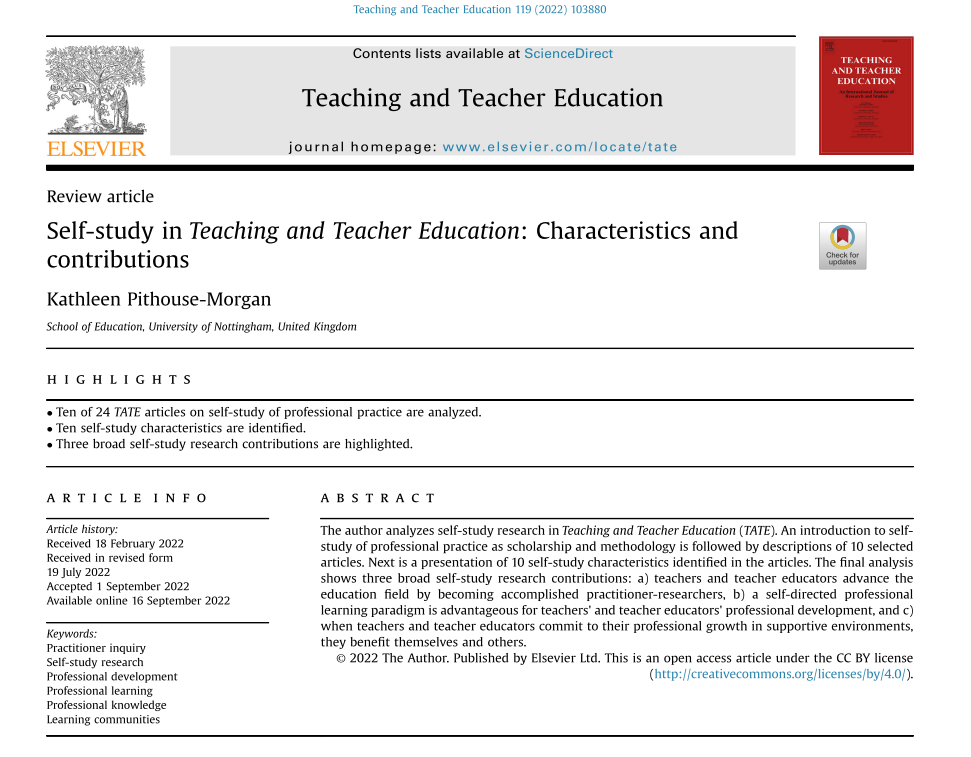
Self-study in Teaching and Teacher Education: Characteristics and contributions
In this I analyzed self-study research in Teaching and Teacher Education (TATE). An introduction to self-study of professional practice as scholarship and methodology is followed by descriptions of 10 selected articles. Next is a presentation of 10 self-study characteristics identified in the articles. The final analysis shows three broad self-study research contributions: a) teachers and teacher educators advance the education field by becoming accomplished practitioner-researchers, b) a self-directed professional learning paradigm is advantageous for teachers’ and teacher educators’ professional development, and c) when teachers and teacher educators commit to their professional growth in supportive environments, they benefit themselves and others.
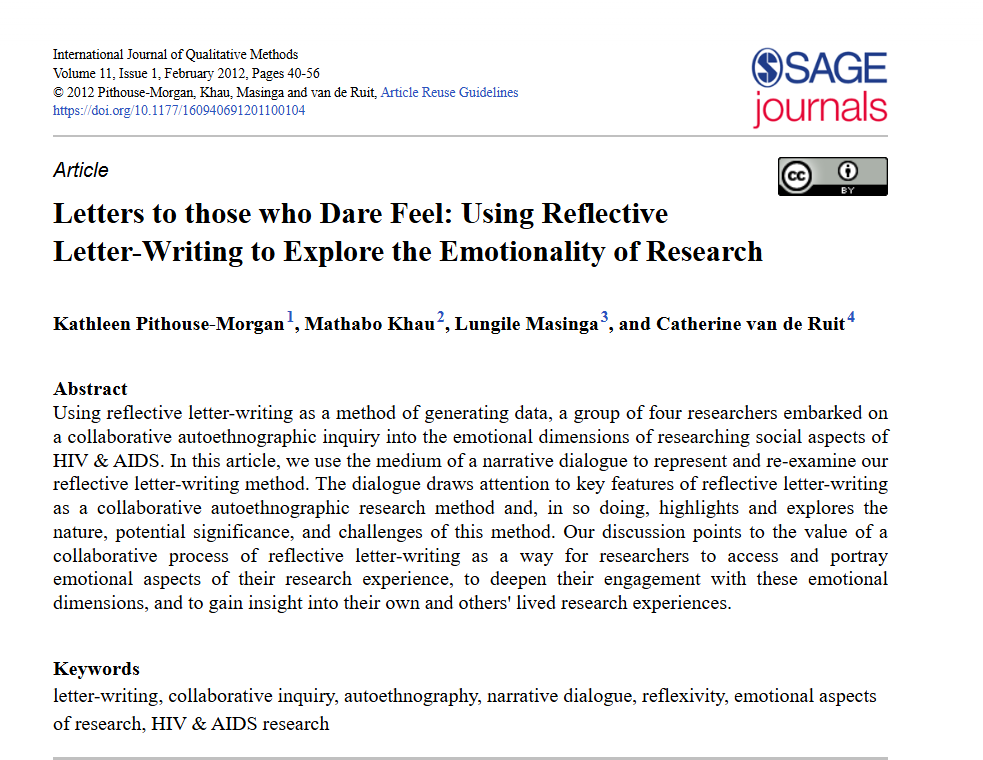
Letters to those who dare feel: Using reflective letter-writing to explore the emotionality of research
Using reflective letter-writing as a method of generating data, we embarked on a collaborative autoethnographic inquiry into the emotional dimensions of researching social aspects of HIV & AIDS. In this article, we use the medium of a narrative dialogue to represent and re-examine our reflective letter-writing method. The dialogue draws attention to key features of reflective letter-writing as a collaborative autoethnographic research method and, in so doing, highlights and explores the nature, potential significance, and challenges of this method. Our discussion points to the value of a collaborative process of reflective letter-writing as a way for researchers to access and portray emotional aspects of their research experience, to deepen their engagement with these emotional dimensions, and to gain insight into their own and others’ lived research experiences.